
Travel can be a rewarding experience for every family, but for families and guardians of children and young people with additional needs, it can also be a source of anxiety and logistical challenge, especially when it involves air travel. In the United Kingdom, there is both a legal framework and a range of practical supports designed to help make the journey smoother, safer and more inclusive. Understanding what’s available and how to access it can turn a potentially stressful experience into a positive one.
By Llinos Edwards
1. Know Your Rights and Plan Ahead
If your child or young person has a disability, reduced mobility, sensory needs or other additional support requirements, it’s important to know that you are entitled to special assistance at no extra cost when flying from UK airports or arriving on UK or EU registered airlines. This applies not only to visible physical disabilities but also to non-visible conditions such as autism, anxiety or learning disabilities (Civil Aviation Authority).
However, to ensure that this support is in place when you travel, plan early and communicate clearly. Most airlines and airports recommend that you tell them about your child’s needs at least 48 hours before departure so that tailored arrangements can be made, from meet-and-assist services to suitable seating (GOV.UK).
2. Special Assistance Services: What They Include
Special assistance isn’t a single service; it’s a continuum of support that can help your family from leaving home to reaching your destination. Key elements include:
- Assistance from drop-off to gate: staff can help you and your child navigate from car parks or public transport, through check-in, security and passport control (Civil Aviation Authority).
- Guided movement through busy areas: if long queues or confusing signage are challenging, special assistance teams can help manage the journey at the airport (GOV.UK).
- Boarding and disembarking: you may be offered help to reach the aircraft door and board comfortably, and similar support on arrival (Civil Aviation Authority).
- Onboard support: while cabin crew can assist with locating seats, storing small baggage and explaining safety information in accessible ways, certain personal care tasks may still need support from a travelling companion (British Airways).
For mobility equipment like wheelchairs or other aids, you are generally allowed to take up to two pieces of equipment free of charge and the airline will arrange for it to be stored and returned to you (GOV.UK).
3. Hidden Disabilities and the Sunflower Lanyard
Many UK airports participate in the Hidden Disabilities Sunflower Lanyard scheme, a discreet way to signal to airport staff that someone might need extra time, understanding or help without having to explain personal details (East Midlands Airport).
Wearing a sunflower lanyard can:
- help staff recognise you may benefit from additional patience and support,
- make it easier to access quieter spaces or alternative routes, and
- support smoother transitions at security or boarding points (East Midlands Airport).
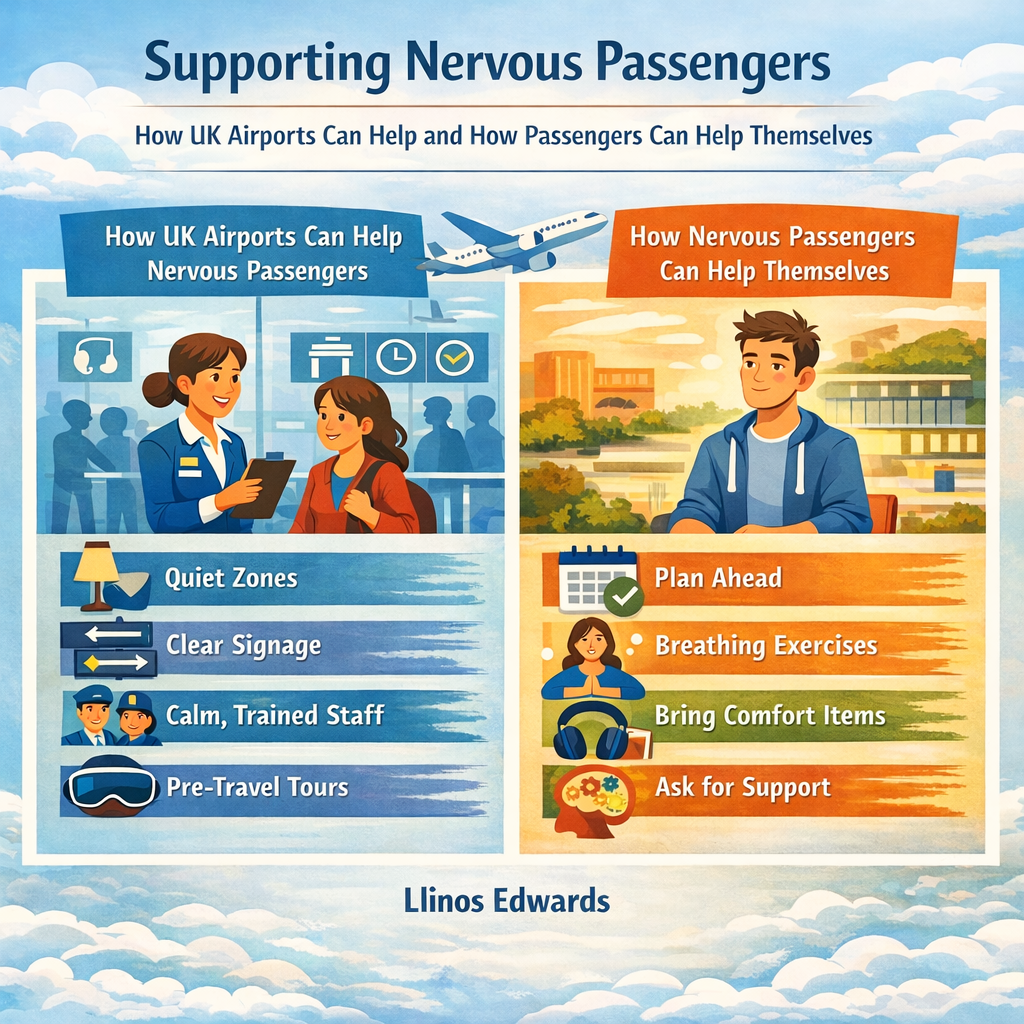
Airports such as Gatwick offer sensory rooms and quiet spaces specifically designed to support passengers with sensory sensitivities on the day of travel (Gatwick Airport).
4. Prepare Emotionally and Practically
For many children and young people with additional needs, especially sensory, cognitive or anxiety-related ones, the unfamiliar sounds, smells, and routines of an airport can be overwhelming. Preparation can make a big difference:
- Social stories or visual schedules help explain what will happen at each stage of the journey, from baggage check-in to boarding (Autism Detect).
- Visit the airport in advance, if possible, so your child can familiarise themselves with the layout and routines (Medway Community Healthcare).
- Bring comfort aids such as noise-cancelling headphones, favourite toys or sensory tools that help regulate overstimulation (Autism Detect).
5. Build a Support Network
Don’t feel you have to do this alone. Share your plans with the airline, talk with assistance staff when you arrive at the airport, and don’t hesitate to ask questions. Many carers encourage families to carry a brief letter explaining specific needs; this can help staff understand and respond more effectively (Scope).
Finally, while the UK’s framework for accessible air travel is robust, experiences can vary across airports and airlines. Recent recommendations from accessibility task forces highlight the need for better, consistent disability training for staff and clearer information for passengers, meaning the situation continues to improve (GOV.UK).
With preparation, clear communication and by using the supports available, families of children and young people with additional needs can make air travel a more manageable, even enriching experience.
References
- British Airways. (n.d.). Assistance hub.
- Civil Aviation Authority. (n.d.). Accessing special assistance.
- Civil Aviation Authority. (n.d.). Your rights as a passenger with a disability or passenger with reduced mobility.
- East Midlands Airport. (n.d.). Travelling with autism.
- Gatwick Airport. (n.d.). Accessibility at Gatwick Airport.
- GOV.UK. (n.d.). Transport support services for people with disabilities: Planes.
- GOV.UK. (2023). Flying to become more accessible as Baroness Tanni Grey-Thompson sets out key recommendations for aviation industry.
- Medway Community Healthcare. (n.d.). Additional support.
- Scope. (n.d.). Air travel for passengers with disabilities.
- Williams, K. (n.d.). Air travel tips for children with autism: UK parent guide. Autism Detect.