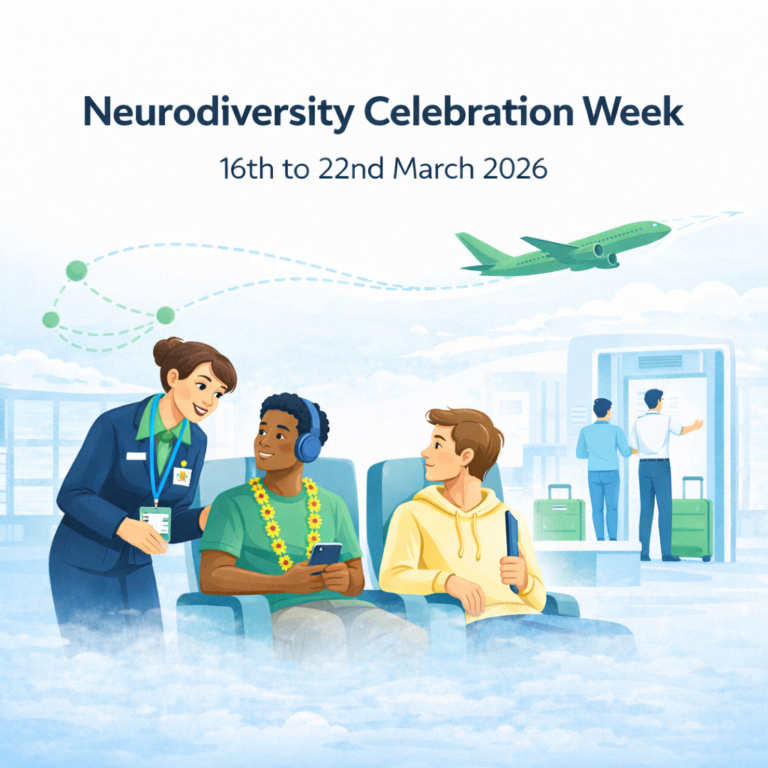
Air travel is inherently stressful: bright lights, sudden noises, crowds, frequent changes in instructions. For neurodivergent travellers, such as people with autism, ADHD, dyslexia, dyspraxia or other neurological differences, these factors can escalate anxiety, disorientation or sensory overload. As the demand for accessible travel rises, UK airports and airlines must deepen their commitment to supporting neurodiversity with design, training and compassionate processes.
The Growing Need: Recent UK Statistics
Accessibility demand at UK airports is rising sharply. In 2024, approximately 5.5 million passengers requested assistance at UK airports, about 1.9% of all travellers, up from 1.69% in 2023 (when 4.6 million did) and 0.94% in 2010 (Civil Aviation Authority [CAA], 2024).
Most assistance requests (86%) in 2023 were for travellers with reduced mobility needing help moving through airports (CAA, 2023; ITIJ, 2023). Although these figures primarily reflect mobility needs, they underline a broader trend: more passengers require tailored support, including for non-visible needs (CAA, 2024; CAA, 2023).
Moreover, passengers with disabilities consistently report lower satisfaction with their air travel experiences compared to non-disabled travellers (CAA, 2024; Department for Transport, 2025). In one survey, 59% of passengers with disabilities said they experienced difficulties navigating airports (Travel Weekly, 2025).
These trends highlight an urgent imperative: investing in neurodiversity support is no longer niche, but integral to accessible air travel.
1. Designing Sensory-Aware Spaces and Quiet Zones
One effective measure is to provide sensory rooms or calm zones in terminals, spaces with subdued lighting, sound absorption, low visual clutter, and seating where travellers can decompress. However, these facilities remain rare. Research indicates that only three out of seventeen UK airports currently offer sensory rooms (Bristol, Gatwick, Heathrow Terminal 3) (Altogether Travel, 2022).
Expanding such zones, ensuring they are well-signposted and accessible throughout operational hours, makes a real difference. Airports should also integrate sensory maps, visual floor plans with triggers, quiet pathways and “busy zones” flagged to help travellers plan their route.
2. Clear, Multimodal Communication and Predictability
Neurodivergent travellers often benefit greatly from consistency and clarity in communication. Airports should provide visual guides, social stories, or video walkthroughs that map the journey through check-in, security, and boarding (APH, 2022). Many UK airports already do this: for instance, Gatwick publishes an autism-friendly guide, while Bristol offers downloadable booklets explaining terminal layouts (APH, 2022).
Staff announcements and signage should use simple, unambiguous language, paired with pictograms or icons. Digital displays that show a countdown to boarding or gate change notices can reduce anxiety caused by sudden changes.
3. Staff Training, Awareness and Empathy
Compassionate, informed staff are a cornerstone of accessibility. Training programmes should cover recognition of neurodiversity, communication strategies, patience in processing time, and accommodating non-standard requests. Some UK airports already partner with organisations like Hidden Disabilities Sunflower and the National Autistic Society to run awareness programmes (Manchester Airport, APH; Collaboratory, 2024). Importantly, training must be ongoing, refreshed regularly and embedded in organisational culture, not a one-off checkbox.
4. The Hidden Disabilities Sunflower Lanyard Scheme
The Sunflower Lanyard (green lanyard with a yellow sunflower motif) enables travellers to discreetly indicate they have a hidden disability and may need extra time, patience or assistance. It does not entitle them to skipping queues, only to understanding and supportive response (The Collaboratory, 2024; Hidden Disabilities Sunflower, n.d.). The scheme began at Gatwick in 2016 (Wikipedia, 2025) and has since been adopted by many UK airports. Birmingham Airport recently updated its lanyard check-in process to ensure better visibility and staff support (Passenger Terminal Today, 2023).
For the lanyard to be effective, every frontline staff member (security, retail, airline representatives) needs awareness of its meaning and protocols for offering help.
5. Inclusive Design from Terminal Planning to Boarding
When designing or refurbishing terminals, airport planners should involve neurodivergent travellers directly. Their lived experience can inform decisions around lighting (avoidance of flicker or glare), acoustics (minimising reverberation and background noise), floor patterns (reducing visual “busy” surfaces), and logical spatial zoning. Pre-boarding or quieter boarding lanes should be offered to those who find crowded boarding stressful. Some airports already allow bypassing busy retail areas or passport control backlogs to reduce sensory burden (East Midlands Airport, APH).
6. Coordinating Airline and Policy-Level Support
Airlines must complement airport efforts. This includes offering pre-boarding, clear communication of delays or gate changes in advance, and permitting comfort aids (noise-cancelling headphones, fidget tools, weighted blankets, etc.). UK passengers with disabilities or reduced mobility are legally entitled to free special assistance when flying to or from a UK airport, including those with hidden disabilities (CAA, 2025). The UK’s Aviation Accessibility Task & Finish Group (AATFG) is working to harmonise accessibility standards across the industry, with a focus on non-visible needs (Department for Transport, 2025). Advocacy and regulatory oversight are vital: a recent report revealed continuing failings across sectors with examples such as missed assistance, broken mobility aids, and inconsistent service (Disability News Service, 2025).
7. Co-Creation: Listening to Neurodivergent Voices
Airport and airline policies should be co-designed with the neurodivergent community through consultation panels, user testing and feedback mechanisms. For example, Newcastle Airport co-produced a “passport” visual aide that travellers can present at key points (CAA, 2024). This is essential: only by hearing from those with lived experience can we identify real pain points and effective accommodations.
Conclusion
Supporting neurodiversity in UK air travel is not optional, it’s a necessary evolution towards equal access. As assistance demands rise and conventional mobility support increasingly saturates capacity, focusing on inclusive design, staff empathy, and clear communication is essential. By listening to neurodivergent travellers, embedding training, and upgrading facilities, UK airports can shift from spaces of overwhelm to gateways of welcome, and not just for some, but for everyone.
By Llinos Edwards
References
- Altogether Travel. (2022, November). Sensory rooms at UK airports. Link
- APH. (2022). Autism & UK airports: what help can you expect. Link
- Civil Aviation Authority. (2023). Airport accessibility performance report 2023/2024 [PDF]. Link
- Civil Aviation Authority. (2023). Flying in 2023: How and why passenger experiences are changing: The experience of disabled passengers [PDF]. Link
- Civil Aviation Authority. (2025). Your rights as a disabled passenger or passenger with reduced mobility. Link
- Department for Transport. (2025). Aviation accessibility task and finish group report. Link
- Disability News Service. (2025, March). Air travel accessibility report could lead to ‘tangible’ improvements but progress depends on industry. Link
- ITIJ. (2025). Disabled travellers: is travel really as accessible as it should be? Link
- Passenger Terminal Today. (2023). Birmingham Airport updates Hidden Disabilities Sunflower service. Link
- The Collaboratory. (2024, April 8). Hidden disabilities. Link
- Travel Weekly. (2025). Passengers with accessibility needs report mixed flying experiences. Link
- Wikipedia. (2025). Hidden Disabilities Sunflower. Link
Join Our Accessibility Advisory Panel
Help shape the future of inclusive air travel. We’re building an advisory panel that brings together disabled passengers, carers, frontline staff, airports, airlines, and regulators. Share lived experience, test ideas, and guide practical improvements across the journey.
➤ Register your interest on our Advisory Panel page
➤ Prefer email? Contact us: info@access-air-bility.com
Your insight turns accessibility from a box-tick into a competitive advantage and makes flying fairer for everyone.